
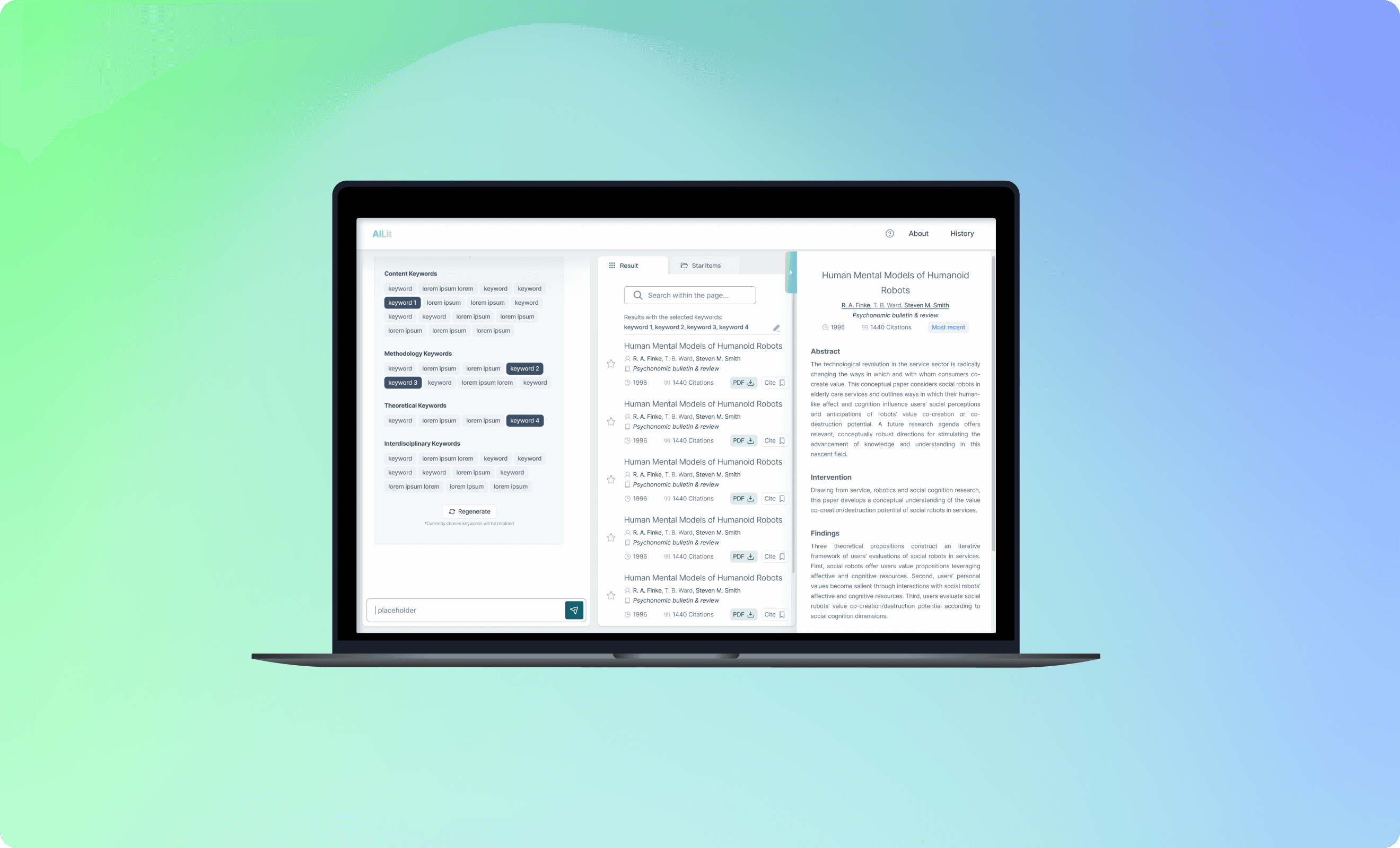
As a UXUI designer, I helped shape the AI-assisted literature search experience at Transformative Learning Technologies Lab ↗. I identified key pain points in literature hunt through user research, designed AI-assisted keyword generation and optimization flows to improve search efficiency and recommendation relevance, and built a design system with unified typography, color, and component standards to support consistency and faster team cooperation.
Product
AI-powered Literature Search Tool
Team
Yolanda (me), UXUI designer
Dora, UXUI designer
Peiying, UX designer
Sabrina, UX designer
Yipu Zheng, product lead & engineer
Timeline
8 weeks (design sprint)
Skills
Design Sprint · User Research · UI design guidelines · Interactive prototyping
Results
The cornerstone for
Curiously won the Catalyst Prize at the 2024 Learning Engineering Tools Competition in 2024 by Yipu Zheng.
About Trust, Transparency, and AI-assisted.
SOLUTIONS HIGHLIGHT
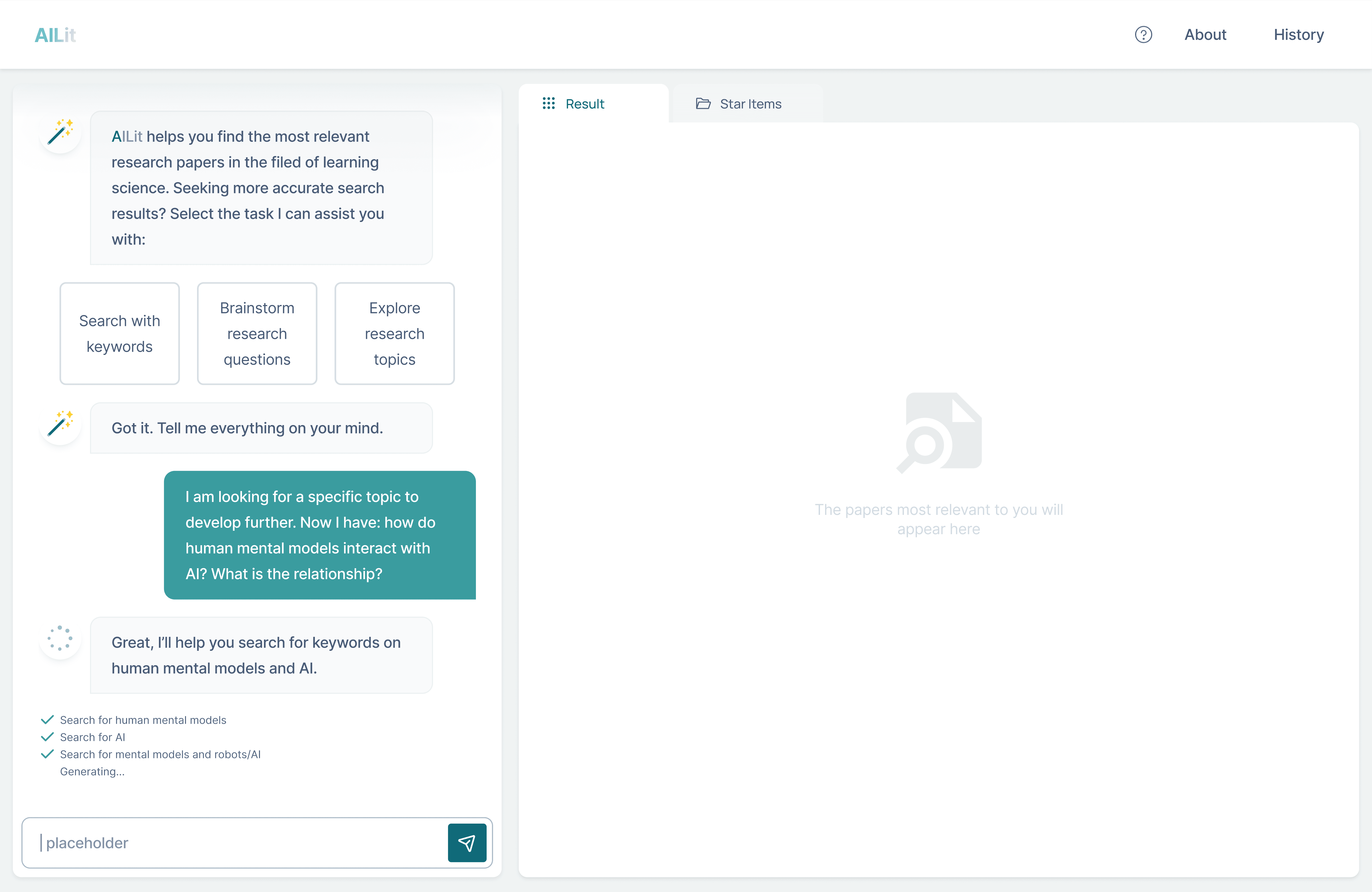
STEP 0 ASK A QUESTION
Making AI Reasoning Visible
In 2023, before visible reasoning became common in mainstream AI products, I explored how exposing intermediate search logic could make AI-assisted literature search more transparent, trustworthy, and easier to steer.
STEP 1 SELECT
Here are the keywords you can use.
Use academic terms over self-created ones for precision.
Instant Feedback: clicking on the keywords refreshes the results on the right automatically
Categorized Keywords: keywords are grouped by categories, content, methodology, etc.
Selection Recap: you can find what keywords selected previously to generate the results
STEP 2 REGENERATE
Don't worry, try again.
It is normal that a one-time search is not enough.
Regenerate Button: click the "Regenerate" button to let AILit refresh itself and do the search again
Search History: you can find first-round keywords in the history by clicking on the pagination
STEP 3 EDIT MANUALLY
Edit by yourself.
It allows manual editing to happen more seamlessly.
Edit and Save: users can manually replace selected keywords with other edited keywords
Sync and Search: the newly edited keywords are synced on the reminder on the chatbot automatically
BACKGROUND
About

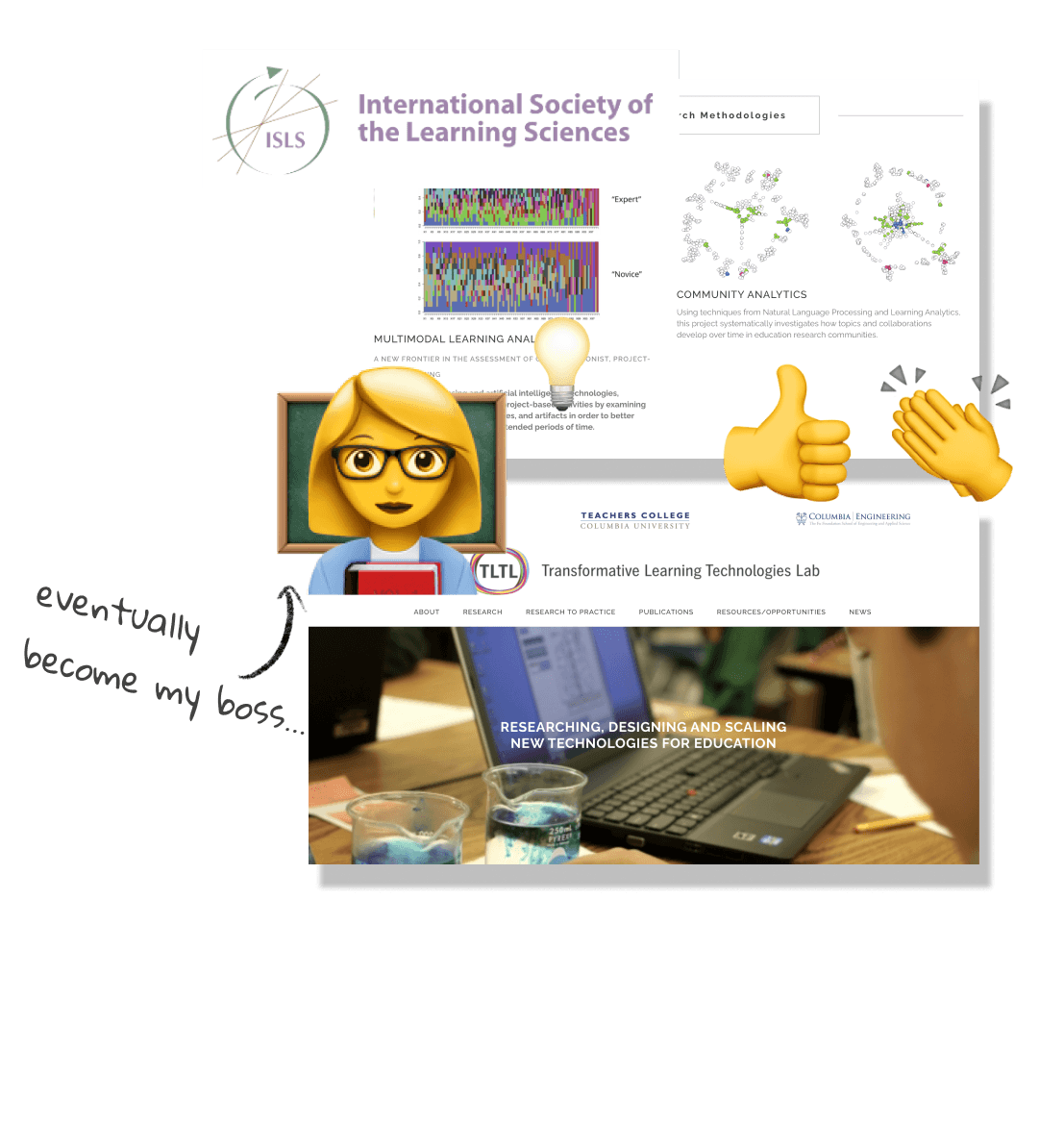
The Transformative Learning Technologies Lab is a STEM education research center at Teachers College, Columbia University. One of the lab’s core missions is to explore emerging technologies and think critically about how they can be applied in educational settings to improve learning.
Why this Project?
At the end of 2022, ChatGPT was released. This project was driven by a simple goal: to identify a problem rooted in students’ everyday lives and explore how this new technology, ChatGPT, or similar AI Chatbot agent, could be used to improve educational outcomes and performance.
Resources
In March 2023, my boss Yipu Zheng published a paper titled “Outside-in, Inside-out, or Outside-out? Exploring the Flow of New Ideas and the Development of CSCL and ICLS via Co-Authorship Networks from 1995 to 2020.” The study analyzed the field of Learning Sciences through keyword analysis and social network analysis, covering all related papers published between 1995 and 2020.
The research produced a large and valuable dataset, including 5,091 papers and 8,225 authors. This became the key resource for our project. Building on this database, we aimed to design a new tool or experience that could translate complex academic research into something more meaningful, accessible, and useful in an educational context.
It's time to think of product ideas.
BRAINSTORM
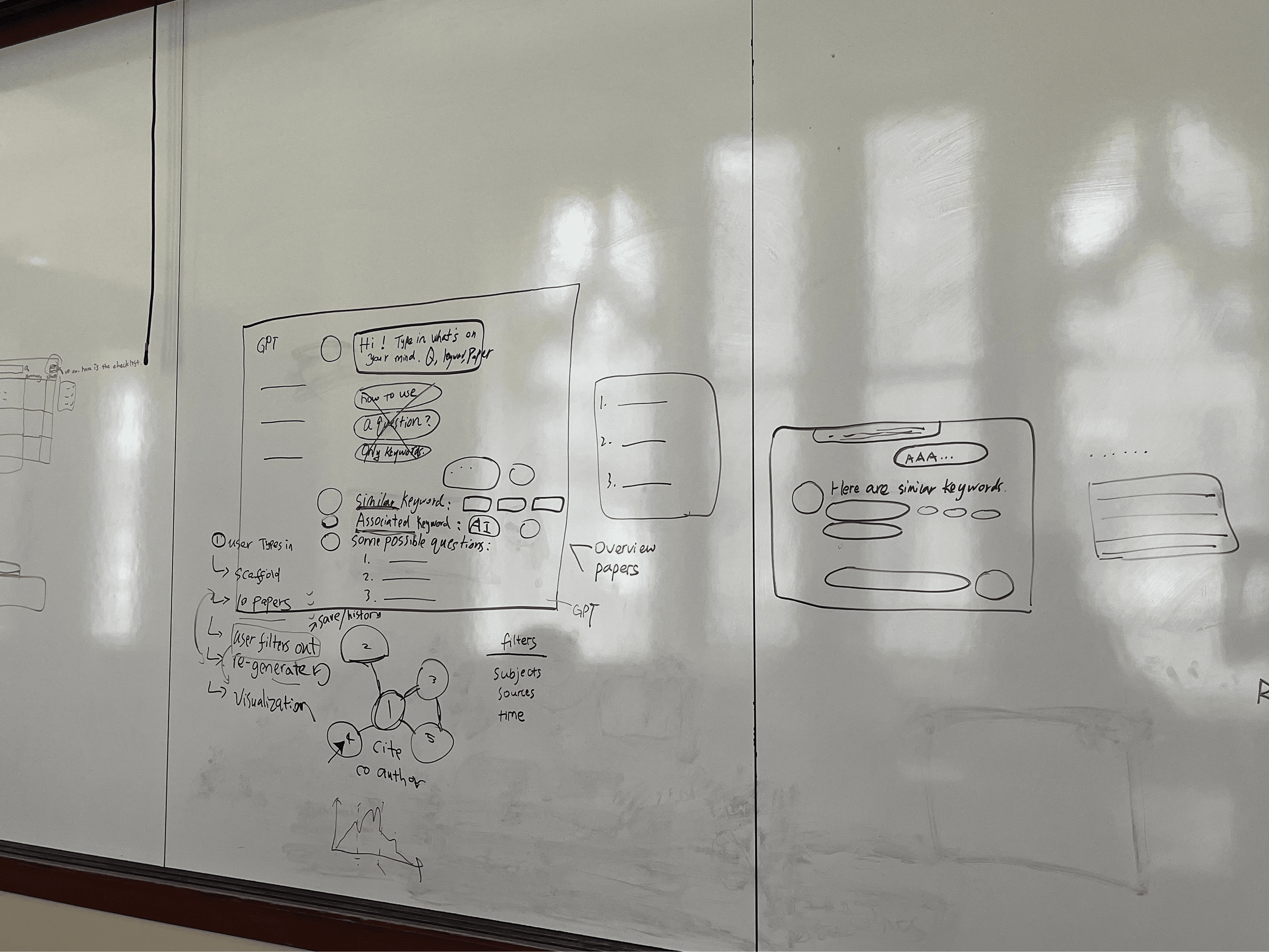
Our first brainstorm session
Doing literature search is a pain
During the first team meeting, we brainstormed about the product ideas. In what scenarios can a ChatGPT-like AI Agent can help students better? We land on the literature research experience itself.
Every college student has to do literature research. And we all know. It is a real pain.
Can ChatGPT help with this? At the beginning of 2023, ChatGPT had limitations. It can only give fake links and sometimes make up research findings.
Questionnaire & Interview & Secondary Research
After brainstorming, we together listed out the specific questions we would like to dig deeper into.
-> Questionnaire
to understand students' research behavior
to know more about their habits in using AI tools
-> Interview
to find reasons, pain points, and problems
to talk about their wild imaginations
-> Research
to understand the strengths and limitations of AI tools
to know the theory behind "how to ask a good research questions"
Ok. So what are the findings?
USER RESEARCH
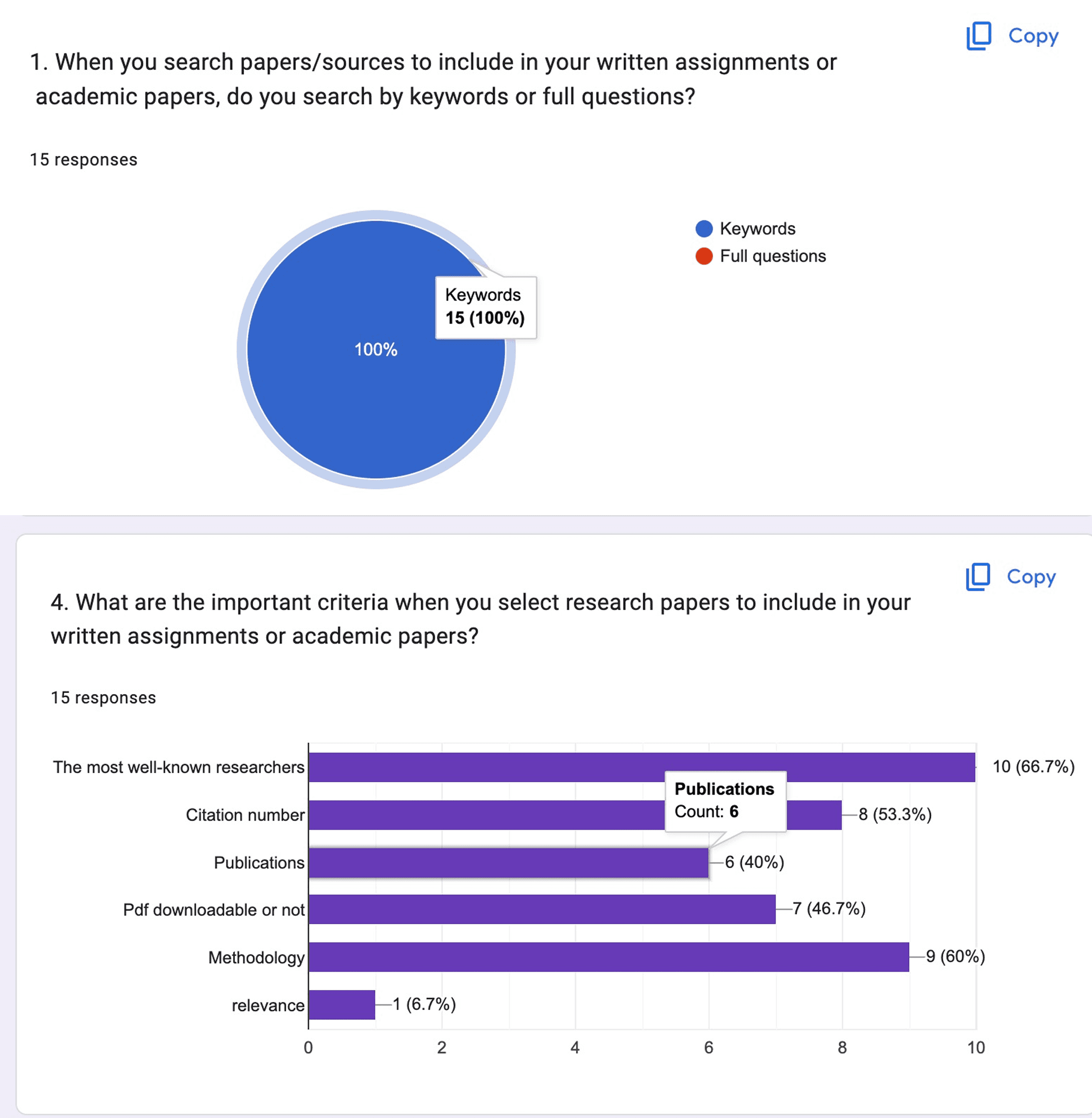
Questionnaire Results
Keywords VS Question
100% students in our samples use keywords during the initial paper hunting process.
They care about impact
Students prefer big titles, researchers, big numbers of citations.
Results in a Page
Counterintuitively, more than half of the students prefer 10~20 results returned in one page. No less than 10, no more then 20.
AI's Role
During the research and interviews, we concluded that AI Agent perform better when they are in an assisted role during the initial search phase.
Time to map out the userflow and do the wireframes.
WIREFRAMES
User flow and decision points
We used mindmap to map the core research journey, including how users enter search intent, receive AI-generated keyword suggestions, refine results, and access recommended papers. This helped define the key steps, reduce friction, and identify where users might need guidance.
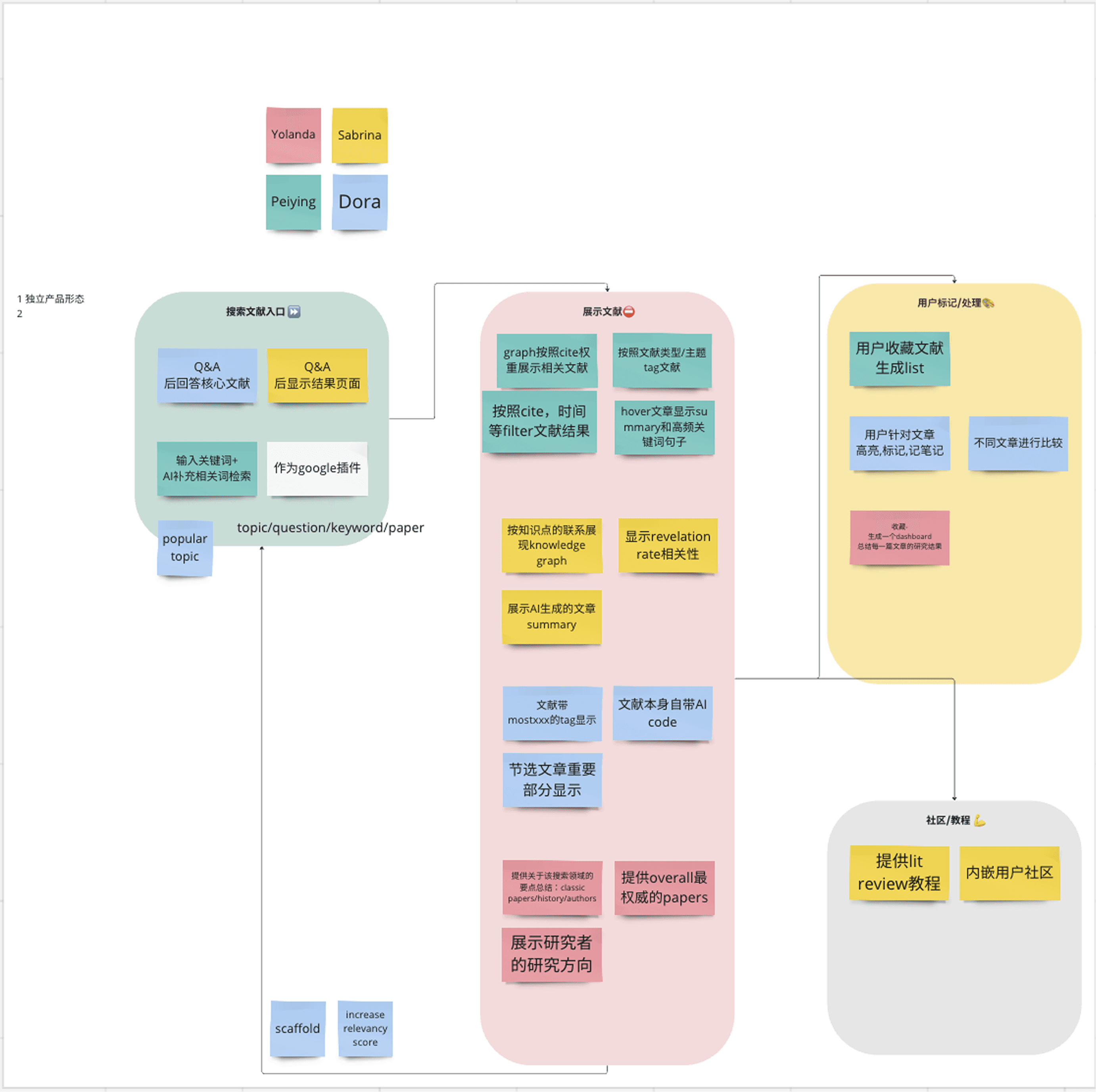
Mindmap Brainstorms
Early validation
The wireframes served as a tool for discussion with teammates and stakeholders, allowing us to align on layout, interactions, and product direction before moving into higher-fidelity design.
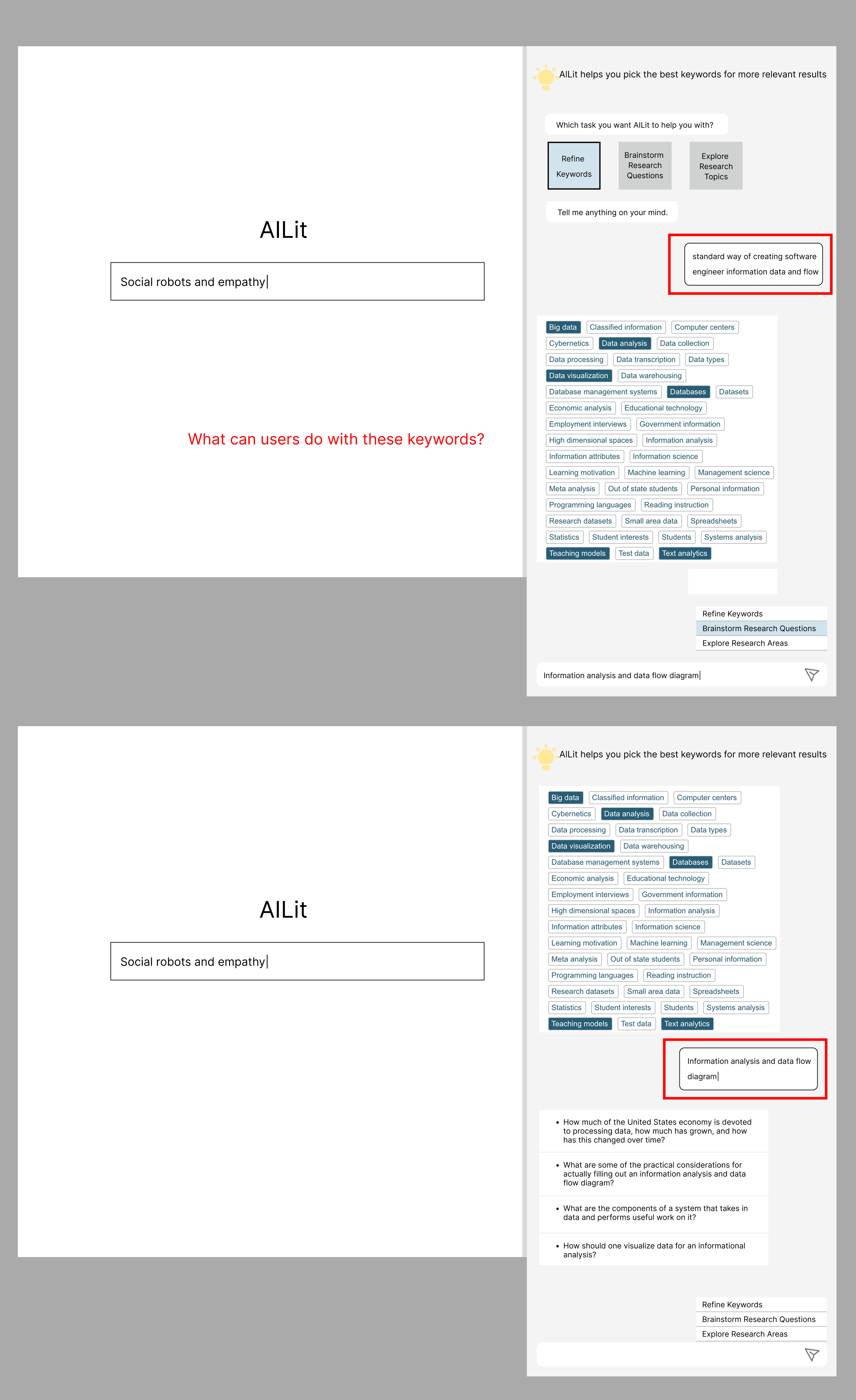
Wireframes
Finally, the results.
THE WHOLE PICTURE

THE UI KIT

USER RESEARCH
Users sometimes don't understand themselves
During the usability testing, I asked about which part you liked the most. Most of the users said they prefer the colorful badges. But it turns out that the badges only look pretty but they do not make sense logically. As a designer, I have to have my own critical judgment over the user feedback.
THEORETICAL BACKUP
Theory complements the interview
Our team reviewed a large number of papers. Through this secondary research process, we built a strong understanding of the topic early on, which reduced the need for more exploratory research later.
